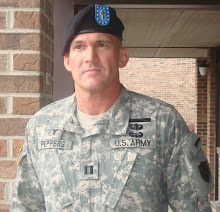
Friday, July 3, 2009

An American Soldier

This is the first installment of a series of reflections I have undertaken to write, based on "The Soldier's Creed." Some, like this one, will have an appeal to the Army values and patriotism, but most will also include a devotional aspect as well.
I welcome any comments ... especially criticism.

-------------------------------------

I am an American Soldier.
I am a Warrior and a member of a team.
I serve the people of the United States and live the Army Values.

(*the rest of the Soldier's Creed is annotated at the end.)


Former President George H. W. Bush, in an interview late in 2007, described his favorite photo of Operation Desert Storm. It depicted a terrified Iraqi soldier in his foxhole, surrounded by American Soldiers. An emotional President Bush recalled, “and the American guy says, ‘We're not going to harm you. We're American soldiers.’”

We’re not like the others, the Soldier was saying. You can count on us to be humane, even amidst the inhumanity of war.

There is something about the claim, “I am an American Soldier” that provokes in me a certain pride—but also the humility of being in undeserved company of greatness. It is the American Soldiers, not the generals or the policy wonks, who have captured the hearts of Americans, particularly since 9/11. TIME Magazine portrayed the American Soldiers in 2003 as, “the bright, sharp instrument of a blunt policy, and success or failure in a war unlike any in history ultimately rests with them.

“For uncommon skills and service, for the choices each one of them has made and the ones still ahead, for the challenge of defending not only our freedoms but those barely stirring half a world away, the American soldier is TIME's Person of the Year.”

Forty years after Vietnam, the American People have rekindled their love for their Soldiers. Whether they agree with the current war or not, people often stop me when I am in uniform, just to say, “Thank you for your service.” It humbles me, having never served a moment in combat, to be thanked for the courageous contributions the American Soldier has been making for six years.

Most of these soldiers are young enough to be my children. Just a few months or a couple of years ago, they wore baggy pants and lip rings, and their biggest challenge had been to master the latest video game. And now they exemplify the best of American values, giving themselves for their buddies and their country.

General Douglas MacArthur, in his famous “Duty, Honor, Courage” speech to the West Point graduating class of 1962, described the American Soldier:

“His name and fame are the birthright of every American citizen. In his youth and strength, his love and loyalty, he gave all that mortality can give. … He has written his own history and written it in red on his enemy's breast.

“…In 20 campaigns, on a hundred battlefields, around a thousand campfires, I have witnessed that enduring fortitude, that patriotic self-abnegation, and that invincible determination, which have carved his statue in the hearts of his people. From one end of the world to the other, he has drained deep the chalice of courage.”

“I am an American Soldier,” says we are different. We are not just soldiers, but we are AMERICAN Soldiers. We don’t abuse prisoners. We defend not only our own freedom but even the faint stirrings of liberty a world away. We flush with discomfiture at the thank yous—after all, “I am an American Soldier; it’s what I do.”


---------------------------
The Soldier's Creed

I am an American Soldier.
I am a Warrior and a member of a team.
I serve the people of the United States and live the Army Values.

I will always place the mission first.
I will never accept defeat.
I will never quit.
I will never leave a fallen comrade.

I am disciplined, physically and mentally tough, trained and
proficient in my warrior tasks and drills.
I always maintain my arms, my equipment and myself.

I am an expert and I am a professional.
I stand ready to deploy, engage, and destroy the enemies
of the United States of America in close combat.

I am a guardian of freedom and the American way of life.
I am an American Soldier.

Thursday, May 28, 2009

How Rumors Start

The first few days up here is a whirl of standing in long lines for chow, then more long lines for record checks, finance, insurance, wills and powers of attorney, and assorted other administrative check points. Then longer lines for medical and dental checks, shots, vision test, more shots and the longest line possible for a 20-minute psych eval.

This morning, I waited an hour and a half to make it in to a waiting room where I got to sit and wait for another hour for a CIF issue. (Central Issue Facility: that's where they issue us all our soldier gear.) Could have been worse, I suppose. We went thru in alphabetical order and there are a lot of letters higher than P.

First we received new NBC suits (Nuclear, Biological and Chemical defense suits, vacuum sealed, along with boots, gloves, a charcoal filter canister, and decon kits). Then the newest ruck sack, which is dramatically improved over the old style, and an assault pack with LBV (load bearing vest) and assorted whiz-bang high-speed attachments, pouches, and other devices that clip, strap and snap on in various configurations.

We got fitted for new IBA (Improved Ballistic Armor: a kevlar vest with pouches for front and rear ballistic plates to protect your torso) and neck protectors, deltoid flaps, and even a groin protector. Thanks to the IBA kit, the duffle bag weighed ... well, I don't know, but I'm a pretty strong guy and I had a hard time with it.

Next was our RFI (Rapid Fielding Initiative) issue. New gloves, several sets of protective eyewear, a new sleeping system (three sleeping bags in one, so you can determine the level of protection you need). And a complete set of Extreme Cold Weather Clothing, that would supposedly keep us warm in weather as cold as 50 below. Not sure if I believe it would keep us warm. But perhaps survivable. The best thing about the RFI issue is we don't have to turn any of that back in. The ECWC is worth well over a grand, so I'm glad I don't have to worry about getting a fat payroll deduction later, if I were to lose track of part of it.

Then after the issuing was complete was (you guessed it) more waiting around, this time for transportation back to the billeting area. Some things just don't change. Hurry up and wait. While we were waiting, the soldiers are chatting, as they always seem to be.

"So why do you think they issued us all that Cold Weather stuff?"

"We're probably going to Afghanistan, not Iraq."

"Or Korea."

"Hey what was that? We're going to Korea?"

"Yeah, haven't you heard the news at chow?" (There is a TV in the chow hall that plays CNN.)

"Oh, that explains why they issued us the ECWC." (Pronounced eck-widk)

Later, a soldier asked me, "Sir, you think we're going to Iraq or Korea?"

Of course, I can't comment here on exactly where we are going in Iraq -- even if I knew -- but our mobilization orders read, "MOBILIZATION IS IN SUPPORT OF OPER IRAQI FREEDOM." But then again, when have orders form the President stood a chance against the inertia of the grapevine?

Tuesday, May 26, 2009

Blessing the Troops

Following is the prayer I wrote for this morning's send-off ceremony at the state capitol.

"Most merciful and gracious God,

"We thank you for the many blessings you have bestowed upon us. All of our needs your hand has provided. By your grace, we have enjoyed unparalleled freedom and opportunity in this land we love and defend.

"As we prepare to depart this assembly, we humbly ask your further blessing upon those gathered. For the leaders of this land, both present and represented, we pray your continued guidance and wisdom, that we and our families might continue to enjoy the blessings of liberty.

"For the loved ones gathered -- wives and husbands, children, parents, friends and family -- we pray that you would grant the calm assurance of knowing that we are in your hands now, and that you care for all of us. Ease the pangs of loneliness, slake the hunger of their souls, and bind together these individuals into one family.

"And for these soldiers gathered, we beseech above all your hand of protection. Although we have the best equipment, the best training, the best leadership possible, we know that ultimately, we are in your hands. As the psalmist wrote so many centuries ago:

"'We who live in the shelter of the Most High, who abide in the shadow of the Almighty, will say to the LORD, "My refuge and my fortress; my God, in whom I trust." For you will deliver us from the snare of the fowler and from the deadly pestilence; you will cover us with your pinions, and under your wings will we find refuge; your faithfulness is a shield and buckler.'

"We ask of you these blessings, knowing that you are ever more ready to hear us than we are ready to pray. We ask all these things for your glory, in accordance with your will, and in your eternal and holy name. Amen."

A Moving Send-Off


Well, we're off. Today the 779th Engnieer Battalion was sent off for duty in Iraq with a moving ceremony and the gratitude of a city and state. At 1000 this morning we had a ceremony in a big courtyard behind the capitol building in Tallahassee.

I was initially scheduled to be on the platform. Just the governor, the TAG (the Adjutant General -- the two-star commander of the FL Guard), my commander, LTC Jarriel, and me. But at the last minute, the Lieutenant Governor wanted to participate, and there were only four chairs on the platform, so guess who got bumped. I don't mind at all. Instead, I came out to the ceremony with the official party and then took my place with the battalion staff in formation. Then at the end, I tripped all the way up the big stairs before asking God's blessings.

The most moving thing about today's sendoff was the escort. (Well, next to Lori being there, and Mom crying her eyes out.) We left the armory in four busses, escorted by probably a dozen or more motorcycle cops from Tallahassee and Leon County. Following our four busses was an "honor guard" of bikers from the Patriot Guard Riders, a motorcycle group that escorts National Guard and Reserve units deploying and returning from Iraq and Afghanistan.

It was hard not to get choked up by their display of support. I was sitting near the front of the lead bus, when the bikers started turning in to the parking lot, one after another, and queuing up. Each bike flew a large american flag. Some of the bikers wore their old military uniforms, and some just wore ... well, biker clothes. Altogether 18 motorcycles and three SUV's lined up to follow us to the capitol.

After the ceremony with the Governor, the Patriot Guard Riders accompanied us to the airport. We drove right up to the flightline and a few moments later we got on the plane, walking past these bikers as they stood at attention with their flags to wish us well.

We arrived at an Air National Guard landing strip in Wisconsin this afternoon, with considerably less fanfare. Then we got in the old yellow school buses and drove to Fort McCoy, where we will prepare for deployment for the next few weeks.

Wednesday, April 8, 2009

Ramping Up For Iraq

For the past three weeks, I’ve been at the Camp Blanding Joint Training Center with my unit, for a five-week pre-mobilization trainup. Pre-mob means that we will be mobilizing soon, and deploying to Iraq after we mobilize. People who have not been in the military might not realize how many different and complicated tasks are required for one Soldier to fight. Most of what we have been doing out here has been Soldier-level or leader-level individual tasks: first aid, moving under fire, manning check points, calling for indirect fire, decontamination, radio communication, signaling, clearing rooms, reacting to contact, and many other combat-related tasks. The Soldiers of the 779th have had late nights and early mornings, with few breaks in the pace.

Some reporters from the Tallahassee Democrat stayed with us for a few days early on. They even wrote an article about the suicide prevention training I’m doing with them. You can find the article at http://www.tallahassee.com/article/20090330/NEWS01/903300315/1010. There is also a video interview with me to the right of the article, on the same page.

Since I’m the chaplain, I cannot carry a weapon, or train with one. Some have noted the irony that, while I wear Air Assault Wings, Parachute Badge, the Expert Infantry Badge and I’m one of three soldiers in the battalion to have a Ranger Tab, I can’t carry a weapon. So I carry a fork. That’s right, tucked in the loops of my IBA (Improved Ballistic Armor) vest is a plastic fork. It was one of our nice plastic forks from home. It looks like pewter. But we’re only training, so it’s plastic. I figure when we get in theatre, I might replace it with a real fork.

It’s really just a conversation piece, and not meant to be a weapon, really. But during a react to contact drill or something, I pulled out my fork while doing these three-to-five-second rushes. (They somehow require so much more effort now than they did twenty years ago). Not to be used as a weapon, mind you. After all, we all know the chaplain is a non-combatant. But I gotta eat.

I’m sad to report that the fork did not make it through all the training. It apparently got smashed between my IBA and the ledge of a window I had to crawl over. A sergeant found the pieces and brought them to me, gingerly holding them in his hands. “Here, Chappy,” he said, “It looks like your fork didn’t make it.” After that I went to carrying a plain old white plastic fork. It just wasn’t the same. Sure, we can get a new puppy.

Besides getting trained myself in whatever tasks don’t require me to engage the enemy (which includes most of them), I have also to care for the spiritual well-being of the Soldiers. Early in our training, I delivered a briefing in the “Maintaining Your Battle Focus” series. My part was “Staying Spiritually, Emotionally and Mentally Fit.” All in thirty minutes. Isn’t Power Point wonderful?

A little later, I had a more lengthy and interactive discussion with them on Combat Stress. It used to be that if a Soldier had battle fatigue, he became a pariah, and was labeled a coward or weak. Now, our approach is to recognize the signs of Combat Stress early, and then get the Soldier a little rest, some hot chow, and maybe a few hours out of the thick of things. (All this is if the situation allows this, as it usually does.) Getting the Soldier to talk about his feelings and getting him back to normal things is part of the healing process. Most soldiers don’t require evacuation out of the combat zone, just a little rest. Of course, more severe cases of Combat Stress require treatment. But most Soldiers with Combat Stress—70 to 85%—can be returned to their combat units within three days.

There are two other related areas I am responsible for training as we prepare to go to war. I’ll talk more later about suicide prevention and preparing the Soldiers’ minds for what they might encounter during “Battlemind” training.

Wednesday, December 3, 2008

Army Chaplain: Mule or Prius?

In the course of CH-BOLC, we have written lots of papers on the topics of our instruction. This is one paper I recently submitted, on the subject, "The Professional Ethic Of an Army Chaplain." Our directions were to answer certain questions, and reference certain external readings. So it wasn't exactly written with a blog in mind. But I thought it might be helpful if someone wanted to know what was the big deal about being an Army chaplain. Enjoy the read. Or at least print it out and use as a cure for insomnia!

The Professional Ethic Of an Army Chaplain
By CH (CPT) Jeff Peppers

An Army chaplain is a unique specimen; to what shall we liken him? A chaplain is at once an officer and a clergyman/woman. It is tempting to describe the relationship between the two qualities in one person as something akin to a hybrid, like say a mule. Of course, a mule is a cross between a female horse and a male donkey, displaying the strength of its mom, and its dad’s surefootedness. The problem with this model is that a mule is neither fully horse, nor fully human. It has characteristics of each, but both traits have been compromised.

Another possible model for Army chaplain is the hybrid gas-electric vehicle. A Prius changes from combustion-based to power cell-based engine, effortlessly and without cue, based on the conditions. But in that model, the vehicle essentially ceases to be one type of engine, to become the other type.

While they come close functionally, both mule and Prius fail to illustrate the unique relationship between officer and clergyman that constitutes an Army chaplain. The Army chaplain embodies all the characteristics of a professional staff officer and a clergy person. These qualities exist without competition, and without compromise. The Army chaplain does not “change hats” continually to vacillate between officer and clergy, but remains a consistent and true embodiment of officer and clergy.

The only model (of which I am aware) that can adequate illustrate this dualism is found in the Christian understanding of the incarnation of Jesus Christ. For the first couple of centuries of the Church, the question of the exact nature of Christ’s divinity and humanity mattered comparatively little to Christian followers and leaders. But when Constantine formally ended the persecution and Christianity became a legitimate religion, leaders began to grapple with the question: how could Jesus Christ be God (or god) and human at once?

The Councils of Nicea eventually settled on what is generally considered to be the historic, orthodox interpretation of the incarnation: that in Jesus, Christ was both fully divine, as well as fully human. This is the nature of the professional ethic of the Army chaplain: fully an officer in the Army, and also fully a clergy member in the service of God. Neither aspect of person is diminished by the reality of the other. The Army chaplain may emphasize one aspect of his ministry over the other from time to time, but does not disengage from being an officer so that he may be more pastoral, and vice versa.

The dual role of the Army chaplain, while hard to enunciate, is easier seen by example. From the earliest days of the Army, chaplains have understood their role. John Gano, a Baptist minister in colonial America, served as chaplain in the Revolutionary War. He was known for his bravery under fire, appearing out near the fighting even through a hail of musket balls. But he was foremost a pastor, preaching to and nurturing the Christian faith among the Soldiers of the upstart American army.

One of the greatest examples of this Soldier-pastor role as chaplain was Father Francis P. Duffy, immortalized as the chaplain of New York’s Fighting 69th and later senior chaplain of the 42nd Division. Father Duffy was a Soldier, through and through, but a pastor as well. He lived by the advice of Chaplain Leslie Groves: “It is the one who lives with the men, enduring the hardships and encouraging the same dangers, who is ruled not by selfishness, but by love for all men … who can speak when the time comes the words that will be listened to.”

The Soldier nature of the pastor simply means that the Army chaplain does his or her duty to promote the moral and spiritual well-being of the unit and its Soldiers, in support of the mission. This does not render the chaplain combatant. Doing one’s duty as a chaplain is akin to doing one’s duty as a commander; positioning oneself at the critical place of the battlefield, the chaplain gives hope and encouragement to Soldiers when they most need it. Chaplains Poling, Fox, Goode and Washington [see blog "Pray That I Might Be Adequate."] placed themselves at the critical place on the battlefield, praying for the men and guiding them to safety as the Dorchester sank under the icy waters of the North Atlantic. Their duty as Soldiers and as pastors melded on the railing of the ship as they escorted the Soldiers under their charge to the last full measure of devotion.

Father Duffy, John Gano, and the chaplains of the Dorchester never gave up being pastors in order to be Soldiers. I consider them to be akin to the Great Soldier, who, “although He existed in the form of God, did not regard equality with God a thing to be grasped, but emptied Himself, taking the form of a bond-servant, and being made in the likeness of men. Being found in appearance as a man, He humbled Himself by becoming obedient to the point of death, even death on a cross.”

Another dichotomy inherent to the nature of the Army chaplain resides within the pastoral component of military chaplaincy. An Army chaplain is a pastor, but a pastor is not necessarily an Army chaplain. In the earliest days of Army chaplaincy, there was no particular training of the chaplain.

The rigors of military life require the presence of chaplains within the ranks. In 1791, Congress authorized the commissioning of a chaplain for the Army, which was at that time the size of two regiments. No rank attended the commission, and the stipend was slightly more than that of a captain.

The nature of ministry in combat, however, requires additional qualities. The Army chaplain today carries the rank of an officer; this is consistent with the chaplain’s duty as adviser to the unit commander on matters of spirituality and morality. In order to advise the commander, and for the sake of credibility among the troops, the Army chaplain must be immersed enough in the Army culture to speak with authority—not only as a messenger of God, but as the combat multiplier he or she is.

Chaplain Milton Haney, of the 55th Illinois Infantry Regiment, received no special training in being a Chaplain in the Union Army. Yet he went about his task as one who knew what had to be done. He freely used his influence with senior commanders to ensure that the wounded were properly cared for, even prevailing upon General Sherman himself for the authority to order doctors to their task on a hospital steamboat. These are qualities of a pastor of action, regardless of military or civil environment.

Being an Army chaplain requires a mindset, as well as technical skills and training, which simply do not apply to clergy in a civilian setting. Chaplains in the Vietnam conflict monitored their command nets, hopped helicopter flights, moved out with their units and dug foxholes with them. Their altar was often the hood of a jeep and they soldiered alongside the Soldiers. Living the life of the Soldier earned the chaplains the respect and love from the men, so needed to bring to them the Word during a moment when they desperately needed it. One Soldier, when asked about his chaplain, replied, “I can’t talk about him. You just wouldn’t understand. You haven’t been with us.”

Chaplains in Desert Storm were assigned to all sorts of units, combat arms, combat support and combat service support. Chaplain Timothy Kikkert of the 4-66th Armored Battalion, while not maneuvering tanks to engage the enemy, understood the general plan and how his unit played in the overall mission of defending Kuwait. The same can be said (or at least, should be said) for chaplains operating in all theatres of war, particularly since World War II. There are military-specific tasks, such as conducting memorial services, ministering in a triage of casualties, and preparing the hearts and minds of Soldiers for combat, for which a civilian pastor need not be concerned.

Fully Soldier and fully clergy, military not civilian, born in seminary and baptized in the fire of combat, the Army chaplain embodies a professional ethic unlike any other. I am proud and humbled to be numbered among them.

Monday, December 1, 2008

Pray That God Will Make Me Adequate

A young chaplain named Clark Poling wrote his to his father, “I know I shall have your prayers, but please don’t pray simply that God will keep me safe. War is dangerous business. Pray that God will make me adequate!”
As he wrote those words, the young RCA (Reformed Church in America) pastor and Army chaplain was being deployed with his unit. Aboard the ship, Clark became friends with fellow first lieutenant chaplains George Fox, a Methodist; Rabbi Alexander Goode; and Roman Catholic Father John Washington. The four found themselves in a fruitful ministry aboard the transport ship Dorchester, serving the spiritual needs of American soldiers headed to the uncertainties of a violent battlefield.
On February 3, 1943, the Dorchester was torpedoed, and rapidly began to sink. Clark Poling and his three fellow chaplains assisted in the evacuation of the ship, calmed the fearful, and guided the wounded to safety. Even with life jackets, the chances of survival were small in the frigid water. But without life jackets the chances of survival were zero. The four chaplains gave their own life vests to others, remaining behind until the ship sank below the surface. One survivor recalled what he saw from the water:
“The last thing I saw, the Four Chaplains were up there praying for the safety of the men. They had done everything they could. I did not see them again. They themselves did not have a chance without their life jackets.”
Of the 940 men aboard the Dorchester, only 230 survived. Many of those who did, at least four perhaps, owed their lives to four clergymen who were found to be adequate for the task.
The Iraqi theater of operations is not exactly Normandy. In five years (+) of fighting, there have been less than one third the casualties of the Battle of the Bulge. The heroes of this war are those who went in early on, and have made it a safer place. Nonetheless, there are still people there who live only to see another American soldier die, so it is not exactly a safe place. Just safer.
As you pray for me and the soldiers of the 779th Engineer Battalion, I ask you to go back to the top and read Chaplain Poling’s request to his father. Pray that God will make me adequate.